The Whitehorse Copper Belt from today back into history
I went on another 4-hour tour of the Whitehorse Copper Belt with Tim Green on August 8th. This one began with an in-depth look of one of Gladiator Metals’ exploratory drill rigs that’s currently operating 2 km from my home, then continued on to the Whitehorse Copper properties that operated from 1966 until 1982, and then we hiked into the bush for a look at some of the earliest copper mines, ending at the Retribution, which was worked from 1902 unti 1907.
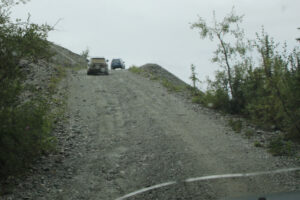
We met at the Mary Lake access to the Copper Belt at 11:45, and after an outline of how the day would go, we began the drive to the Gladiator site. There’s one steep hill that could be a challenge for regular cars, but we all had 4-wheel-drive. I spend quite a bit of time back here, usually on my e-bike.
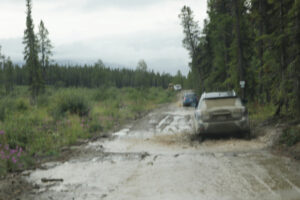
We had extremely heavy rain the previous evening, and the road to the drill rig had a lot of water and deep mud.
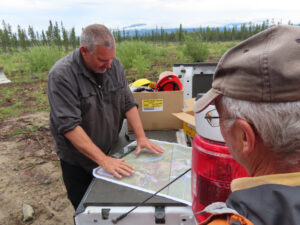
At the Gladiator Metals site we were met by Kell Nielsen, Gladiator’s Vice President of Exploration, and rig geologist Allison MacDougall. A map showed the extent of this exploration project, which began in 2023. A minimum of $40 million is being spent on this program, with 3/4 of that going directly into the Whitehorse economy.
A box full of core samples showed us exactly what was hidden under our feet. Each of the cores had a section that had been polished and lacquered, and some would make amazing kitchen countertops!
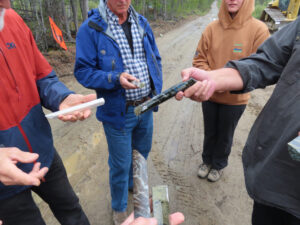
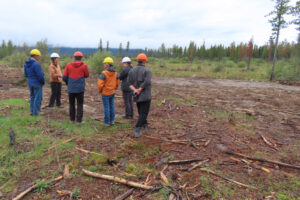
Allison MacDougall, second from the left, shows us what a drill pad looks like when they’re finished. I’ve mentioned this before – even a year later few people would ever know what went on at these sites. The vast cleared area is a tiny part of the ongoing firebreak project which has made things much easier for Gladiator, with access roads and many of their drill sites cleared.
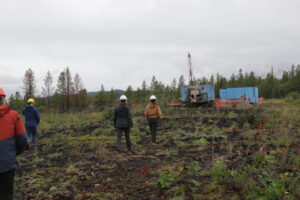
Walking to the drill rig, which is run by Kluane Drilling, a Whitehorse company that has been drilling around the world for 35 years. This rig has tracks like a Cat rather than being on skids, so there is minimal damage to even undisturbed ground.
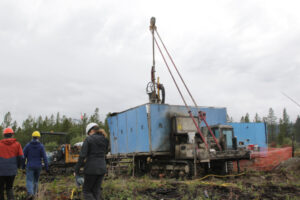
Kell and Allison had already explained some of the drilling techniques used to get the best results, and that continued here at the rig, where we could now see the angle that the drill goes down at.
This pickup load of drill cores will be going into town for study, analysis, and storage. The hundreds of core trays are built in Whitehorse.
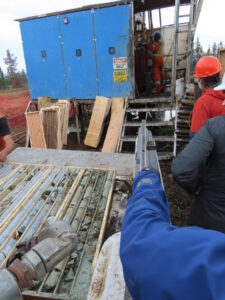
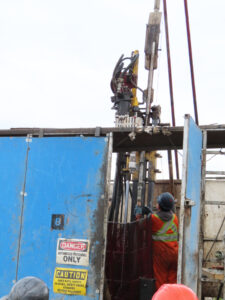
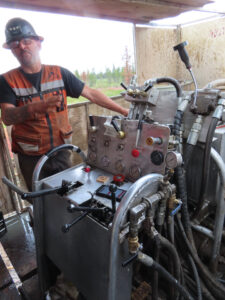
The rig was shut down so we could go into it for an even more detailed explanation of what happens.
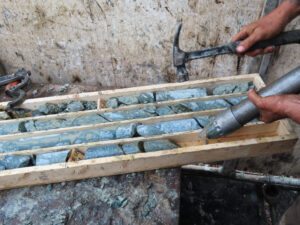
The drill cores are the point of all this work, and great care is taken to ensure that they are extracted and loaded into the trays correctly with their source noted. Some re-assembly of broken cores is sometimes required by the geologists in town.
An important part of the drilling operation is the supply and recycling of the water used to cool and lubricate the drills. In this shed is a centrifuge that spins the slurry (mud) to extract the particles.
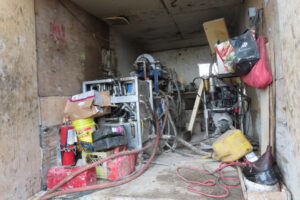
This is the slurry that comes out of the drill hole, that is then pumped up into the centrifuge.
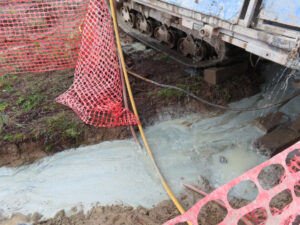
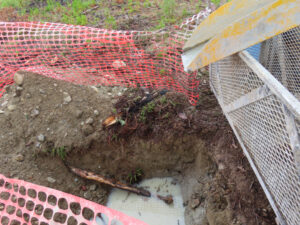
The particles that are extracted from the slurry are pumped into a pit and will be buried. As there are no chemicals or other hazardous contaminants, one of the 98 conditions of the exploration permit allows for that burial.
Our little group spent almost an hour with the folks from Gladiator and Kluane. There were lots of questions, and all were answered honestly. This exploration program is hugely controversial right now because of a rezoning application to allow for an expansion, and a public meeting coming up at city hall soon could be loud. I have been around mines off and on for much of my life, including a spell working underground at BC’s legendary Granduc copper mine 51 years ago, so I’ve seen this process many times. I have always supported ethical mining, and continue to do so. Over and over again, though, Yukoners have been burned by unethical mining companies, and nobody is surprised by the response this drilling is getting. Few people spend more time in the Whitehorse Copper Belt than I have over the past 35 years, and even fewer know the history better, but this blog post may be as involved as I can get in the process. We have a Mary Lake meeting about it in a few days, and I’ll probably attend that, but there’s no way my brain can handle what I expect will go on at the city hall meeting.
Though drilling results have been very positive in some parts of the Copper Belt, there is zero chance that this program will result in an operating mine in the years left in my life. However, it’s impossible to say what economic, technical, and environmental conditions in the future could make viable. A small underground mine seems to be in the range of possibilities.
From that drilling operation we drove toward the Black Cub South pit, passing the other Gladiator/Kluane drill rig on the way. When I was at Black Cub South a week ago I could hear a distant low thumping sound – this is where it was coming from. The Black Cub South pit is probably the best swimming hole in the Copper Belt for a few weeks each summer, but still sees little use.
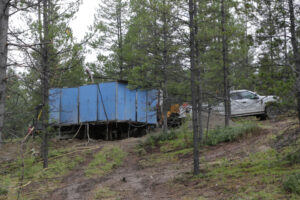
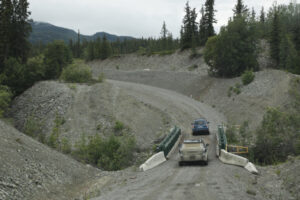
From Black Cub South we drove about 11 km north to the Whitehorse Copper properties, most of it on the main Copper Haul Road. In the next photo, we’re crossing Wolf Creek on a Bailey bridge.
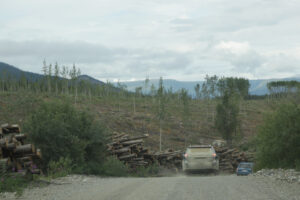
We saw much of the firebreak project.
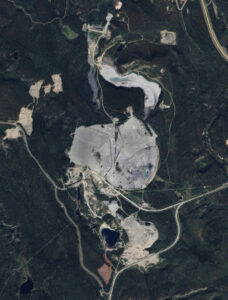
We hiked in to the area where the Whitehorse Copper mill was. The tailings ponds there can be seen even by high-flying aircraft – see an interactive map of it here.
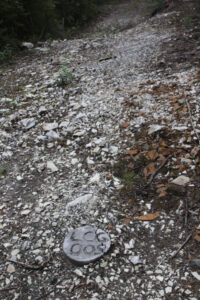
The drill holes from Gladiator’s program in this area are visible now only by the concrete caps on them. This one is in the middle of an old road.
It’s easy to walk around the Whitehorse Copper area today and see little of interest, but with a guide like Tim there’s lots to see and to think about.
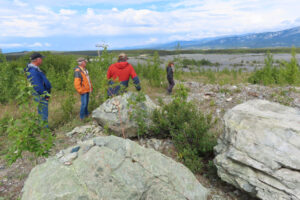
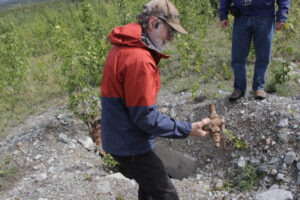
There are still “artifacts” to be found 🙂
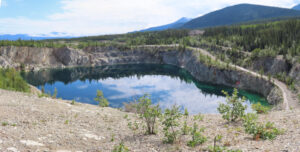
Our final stop here was the most impressive of the pits, the Little Chief. You can see lots of information about the mines on Tim Green’s website – the Little Chief is here.
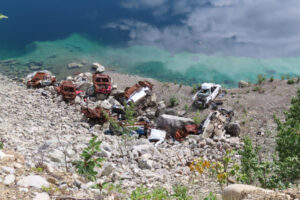
Running cars off the cliff of the Little Chief is quite a sport, apparently, and those without cars to dump turn to things like clothes dryers and stoves 🙁
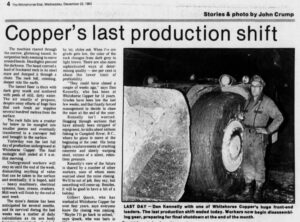
The last production shift underground at Whitehorse Copper ended at 8 a.m. on December 22, 1982. It had been anticipated for months and production had been slowing, but it was still a significant loss to Whitehorse. To some of you reading this, that will be ancient history, but one of the people on our tour worked in the mill at Whitehorse Copper for six years, so for some it’s memories as well as history.
After touring for 3 hours so far, Tim thought that some folks might not want to continue on to stop #3, but we were all in. That stop was a hike into the bush to see some of the earliest claims. I had forgotten my phone so couldn’t map this hike, but this was my third or fourth hike in here with Tim.
I’ll start by cautioning anyone who might think of wandering in here on their own that this area is dangerous, with cliffs and half-hidden pits everywhere, as well as the usual fallen trees, etc, and any “trails” are faint. None of the mines are safe to try to enter.
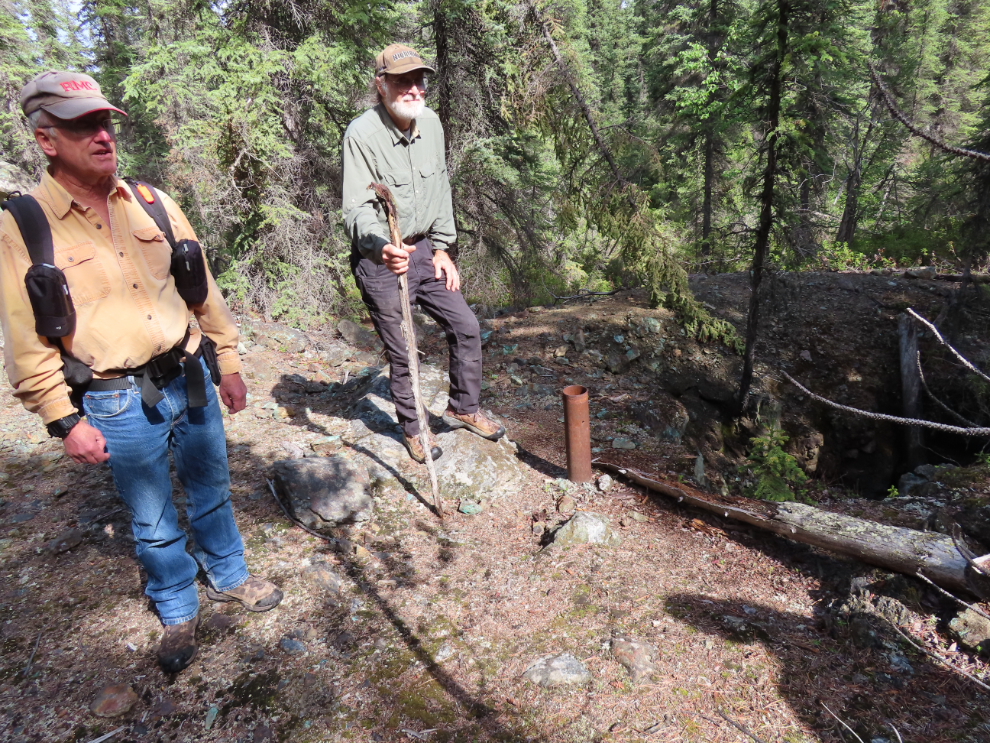
We began at at the Best Chance claim, first staked in 1899, worked most extensively in 1907, and studied again a few times, as recently as 1994. The rock colours here are wonderful!
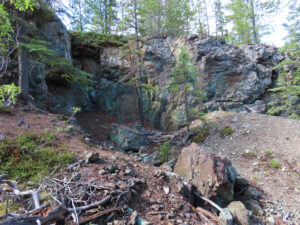
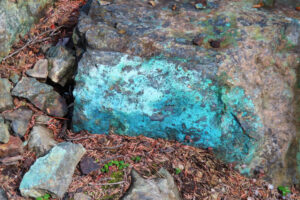
There are two main pits from the 1907 work at Best Chance.
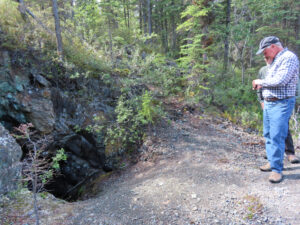
There’s a diamond-drill casing from a later survey beside one shallow pit.
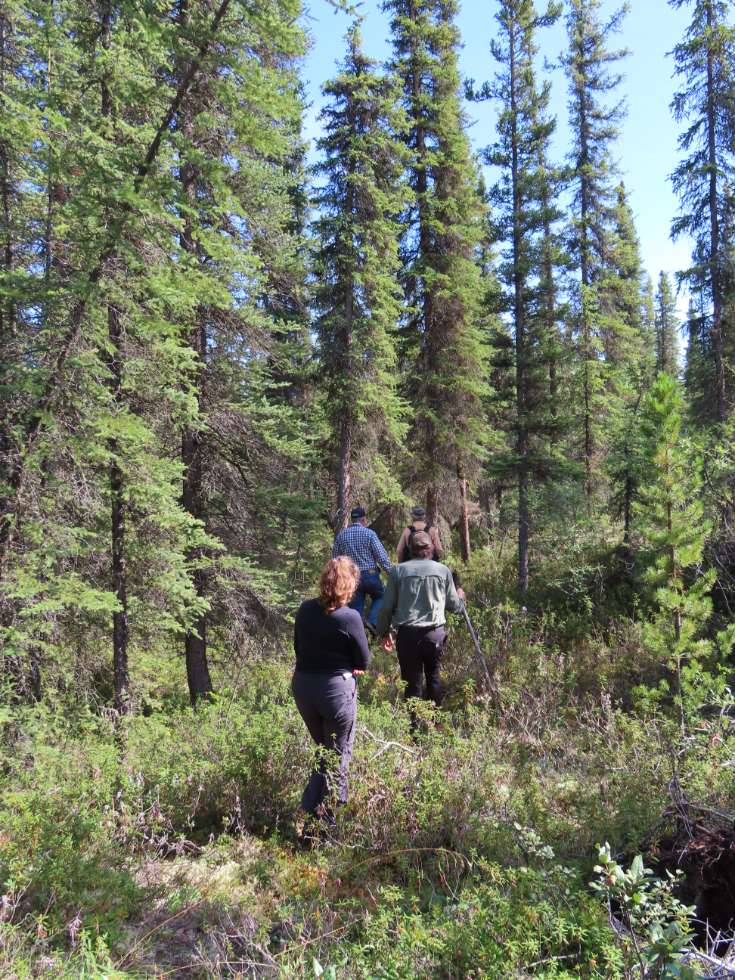
As I mentioned, there are some faint trails, but more often there is no trail.
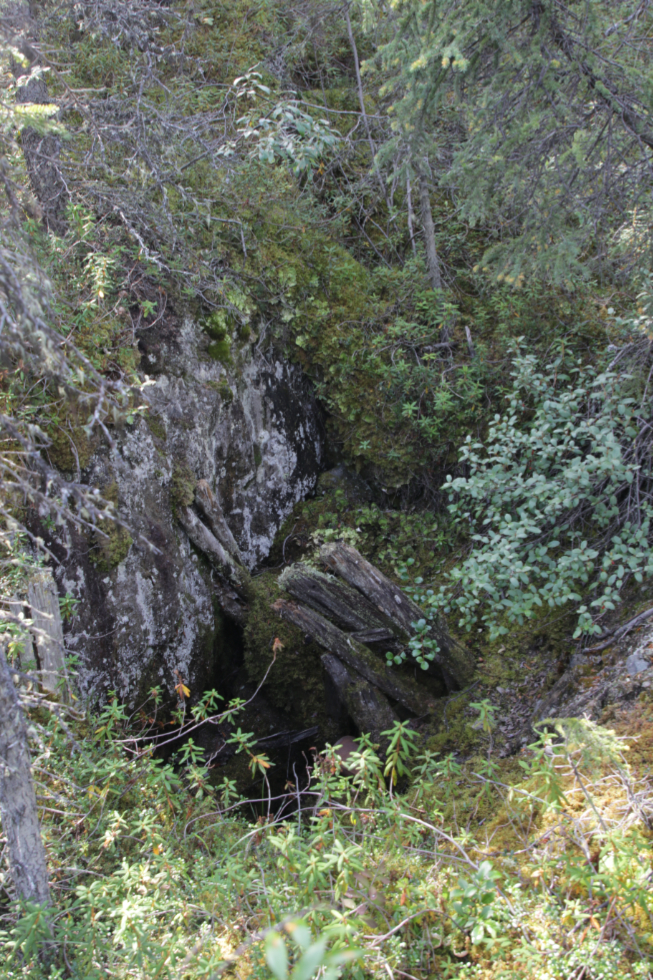
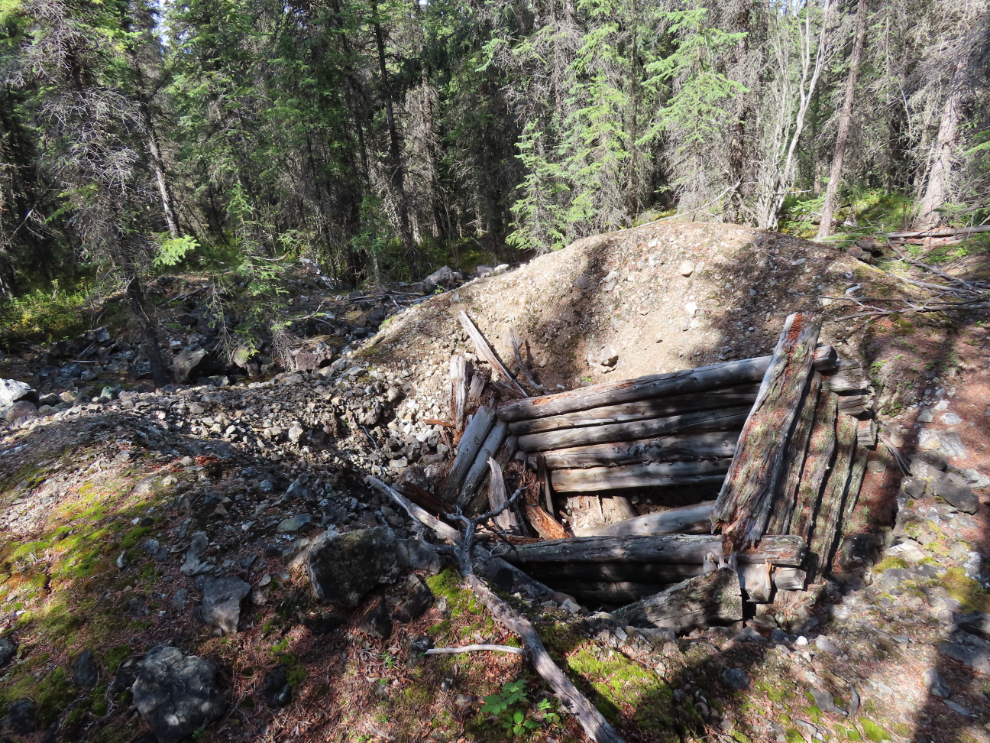
The final claim on our tour was the Retribution, with one pit having fairly substantial log cribbing.
And that was it – another particularly interesting tour led by a fellow whose passion about this subject always excites me. Huge thanks, Tim!
About The Author

Comment
I’m just an old classmate of Tim’s seeing what he’s up to these days. I enjoyed the pictures and the narrative. The knowledge Tim has, his enthusiasm, and his passion for history, are infectious. I mow my lawn here in Ottawa and consider that an adventure! Tim has the right attitude and I predict will live to be 100. He is indeed a treasure.
Thanks for your comments, Chuck. I agree with you 100% – Tim is the sort of people I treasure.